
Thursday · October 1, 2026 · The Petrenko Group
Can You Build a Dock on Lake Norman?
Yes, with a Duke Energy Lake Use Permit, but not by right: shoreline classification, frontage and the 50-foot buffer decide whether your specific lot can hold a pier.
Full Lake Norman market section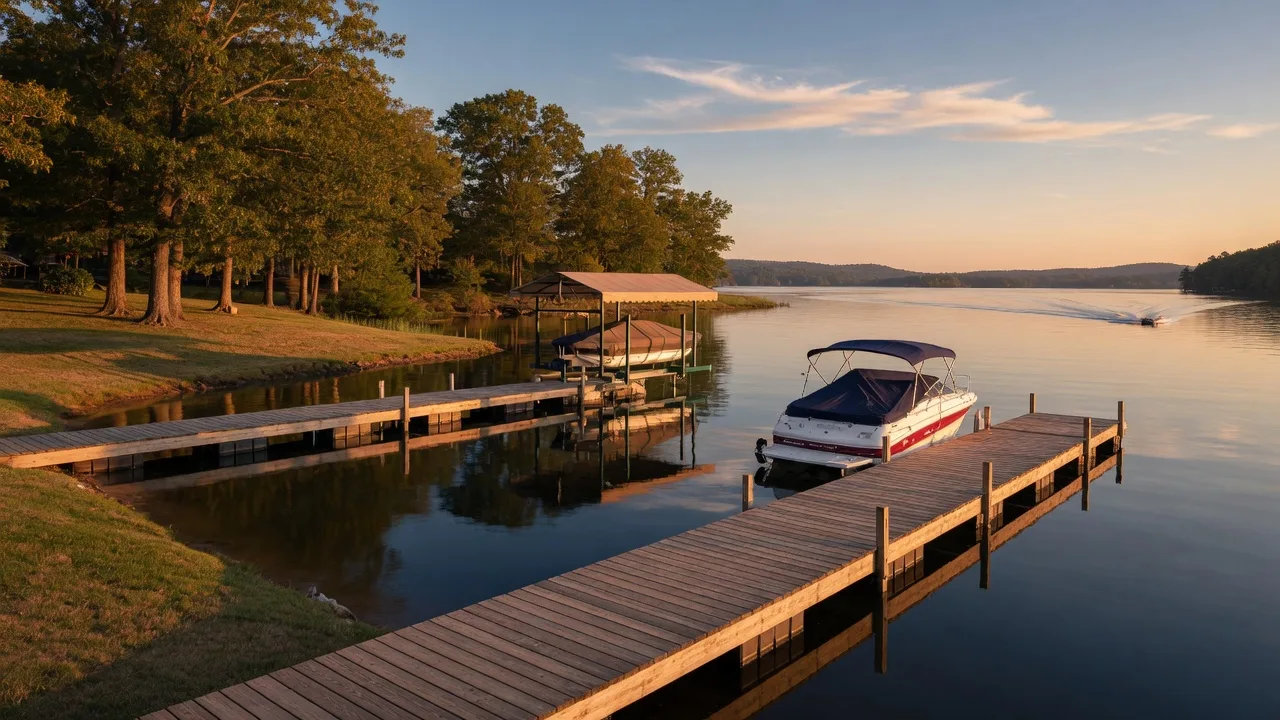
Yes, you can build a private dock on Lake Norman, but never by right. Every pier, walkway and boat lift on the lake sits on Duke Energy land below the 760-foot full-pond line, so each project needs a Duke Energy Lake Use Permit under the Catawba-Wateree Shoreline Management Program before anything is driven into the water. Whether a specific lot can actually qualify depends on its shoreline classification, its frontage, the depth profile off the bank and the 50-foot buffer, which is why the dock question belongs in the first week of due diligence, not the closing countdown. On most developed waterfront lots in Iredell, Mecklenburg and Lincoln counties the answer is yes; on a vacant lot or a view-only listing, it may be no.
The permit that controls every dock on the lake
Duke Energy operates Lake Norman under a federal hydroelectric license, and its Catawba-Wateree Shoreline Management Program governs everything built at or below the lake's 760-foot full-pond elevation. A private dock, pier, boat lift or boathouse requires a Lake Use Permit applied for through Duke Energy's Lake Access Permit System, and the permit is tied to the property rather than the owner, so it stays with the deed when the home sells. Standard private-dock reviews typically run four to twelve weeks, which means permit timing belongs in your offer and closing timeline, not in a surprise after closing.
The application itself needs a registered survey, a plan and profile drawing of the proposed facility, photos of the shoreline, and any county or state approvals the project touches. Duke Energy's review is the gatekeeper, but it is rarely the only approval in the pile.
The 760-foot line and the 50-foot buffer
On Lake Norman, property rights generally extend to the 760-foot elevation contour, the lake's full-pond line, and Duke Energy owns and controls the land below it where docks sit. Measured from that same 760-foot line, a 50-foot buffer keeps structures, major grading and removal of existing vegetation off the immediate bank, with the permitted dock itself the exception. North Carolina's Catawba riparian buffer rules and the state's water-quality review add their own vegetated setbacks on top, so a shoreline plan on Lake Norman can touch two or three approvals rather than one.
Dock size follows your shoreline classification
There is no single lake-wide dock size on Lake Norman. Duke Energy classifies every shoreline segment and sets what a parcel may build from its classification and its frontage: allowable dock length, square footage and slip count all vary by cove and segment, and covered or roofed slips change the calculation and can trigger a denial. Narrow coves get evaluated on the width of the cove mouth, and a dock generally may not extend so far that it blocks navigation or a neighbor's access. The practical takeaway: two lots on the same lake can have very different permitted envelopes, and the classification is a fact you request, not a guess you make.
When a listing advertises a big covered boathouse, ask whether the structure matches the approved plan. Additions built without approval do not grandfather themselves just because they are old.
What makes a Lake Norman lot non-dockable
The common blockers are specific and knowable. A shoreline classification in a protected or environmentally sensitive segment may not allow docks at all. Some waterfront parcels carry no private dock rights, or share them through a community or association dock. Steep, rocky banks make shore access and a compliant walkway impractical. Shallow water at normal low level can force a dock length beyond what the classification allows, and state water-quality review generally expects usable depth at the dock location. Too little frontage, side setbacks, utility easements, HOA covenants and proximity to a navigation channel can each eliminate the build on their own.
A non-dockable lot is not a bad property. It is a different property, priced accordingly, and it can be exactly right for a buyer who wants the view and the water access without the maintenance of a pier. Just do not pay dockable money for it.
What the market pays for a dock
The premium is real and consistent. Waterfront single-family sales on Lake Norman ran a median around $1.65 million in mid-2026 per one local tracker, while the broader Lake Norman area, water and off-water combined, sat near a $670,000 median at the end of 2025. Deep-water homes with a permitted dock and a covered lift are among the fastest-moving listings in the market, and community averages reflect it: Cornelius waterfront averaged roughly $3.8 million and Davidson roughly $3.2 million in 2026, both up more than 50 percent over five years.
Buyers who want to keep a boat at home bid for depth and a clean permit record, and that is the segment that holds its value through a dry year and at resale.
How to verify before you offer
Ask in writing for the shoreline permit history tied to the deed, the Duke Energy shoreline classification for the segment, the survey note showing the 760-foot contour and the buffer line, and depth readings at the dock and along its face. Walk the bank at water level and look for the features that kill builds: steep drop-offs, shoaling water, a cove mouth that is too narrow, an easement crossing the dock zone. A listing that answers the dock question with adjectives, deep water, great fishing, should prompt follow-up, not an offer.
On Lake Norman, the permit record and the depth profile are the two facts that separate a confident offer from an expensive surprise. Bring them to the table and the water will tell you the rest.
The bottom line
Yes, you can build a private dock on Lake Norman, but the yes is conditional: Duke Energy must approve the build below the 760-foot line, the shoreline classification and frontage must allow it, and the 50-foot buffer and state rules still apply. Most developed lots with a documented slip will re-permit; vacant lots and view-only parcels need verification before you commit. Ask for the classification, the permit history and the depth profile early, and let those facts set your numbers.
Have a question about lake norman waterfront? Ask an advisor who walks these docks weekly.
Talk to Vic and AmyContinue reading
All entries
Lake Norman · September 1, 2026
The Lake Norman Waterfront Buyer's Guide: What to Know Before You Make an Offer
Due Diligence · September 3, 2026
Docks 101: How Duke Energy Shoreline Permits Work on All Three Lakes
Lake Wylie · September 5, 2026
Lake Wylie Communities: From Tega Cay to the Catawba Border
Private consultation
Bring us your shoreline questions
Depth at the dock, permit history, buffer lines, comparable sales: tell us what you are evaluating and we will bring you the facts.
The Petrenko Group · Premier Sotheby's International Realty · 138 Village View Lane, Mooresville, NC 28117.