
Thursday · October 8, 2026 · The Petrenko Group
How Deep Should the Water Be When Buying a Mountain Island Lake Waterfront Home?
There is no single minimum depth on Mountain Island Lake, but there is a working depth for your boat: about three feet for a standard lift, six to seven for a heavy-duty one, measured at the dock face at full pond and in a dry year.
Full Mountain Island Lake market section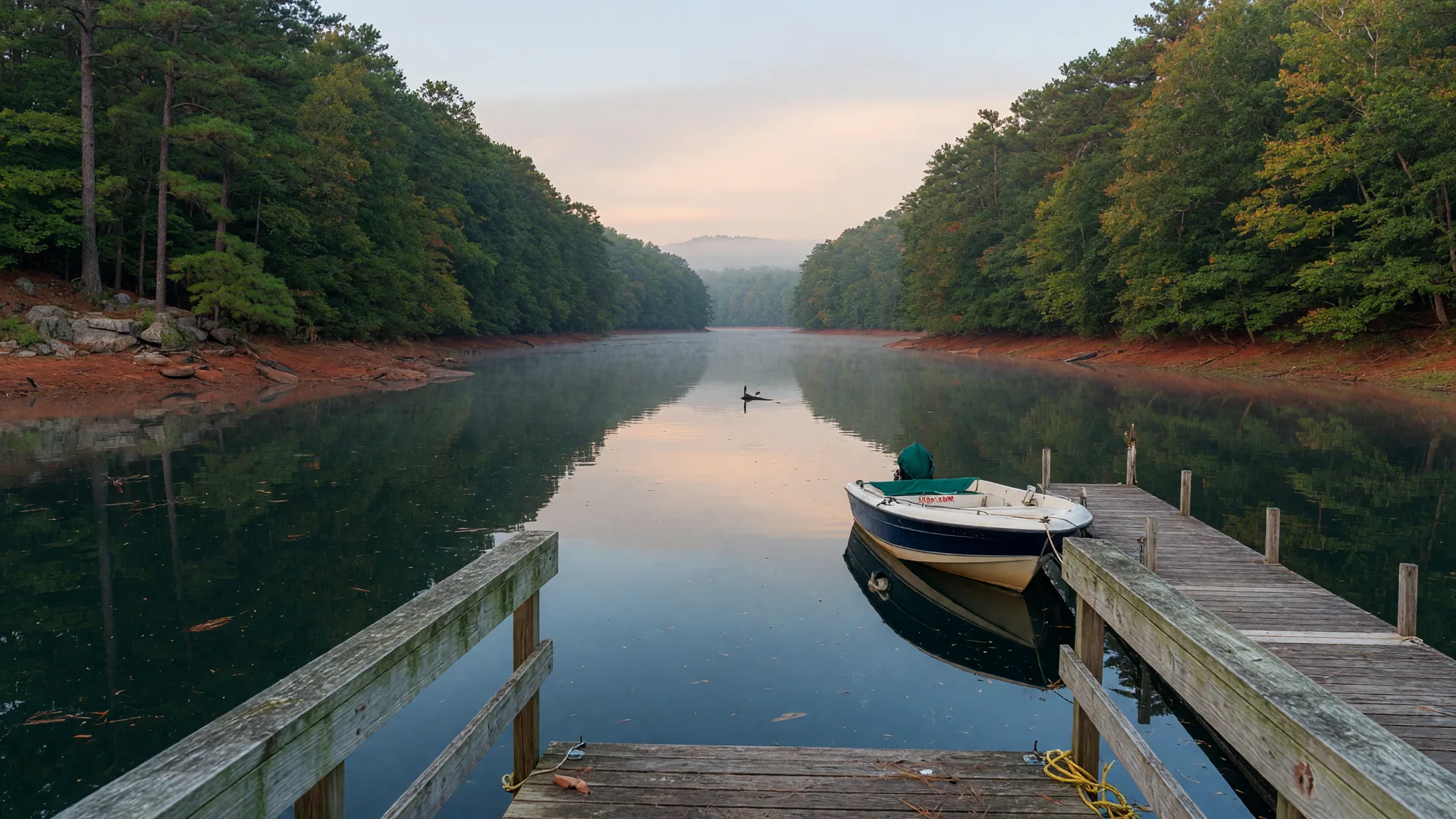
There is no single minimum water depth required on Mountain Island Lake, but there is a working depth for every boat you plan to keep there, and it is usually lower than buyers expect. A standard boat lift operates in roughly three feet of water; a heavy-duty lift rated for a large boat needs closer to six or seven. The common planning rule is your boat's draft plus about nine to twenty-four inches of cradle clearance at the dock face. Mountain Island Lake's full-pond line sits at 647.5 feet above sea level, its average depth runs only about 16 to 17 feet, and its coves shoal quickly off the bank, so the question is never how deep the lake is but how deep the water is at this specific dock, at full pond and in a dry year. That number, not the adjectives in the listing, is what you are paying for.
Why Mountain Island Lake depth is different from the bigger lakes
Mountain Island Lake is the smallest of the three Catawba reservoirs, roughly 3,281 acres with about 61 miles of shoreline across Mecklenburg and Gaston counties, and it is the only one of the three that is also a working drinking-water reservoir, supplying the majority of Charlotte's and Mecklenburg County's water. Its full-pond elevation is 647.5 feet above mean sea level, compared with the 760-foot full-pond line on Lake Norman and the 569.4-foot line on Lake Wylie, and its average depth runs only about 16 to 17 feet, with the deepest water near the dam reaching roughly 52 to 60 feet. That deep main-channel water is the exception, not the rule: most listings sit on narrow coves and feeder creeks where the bottom shoals quickly, and the lake's protected shoreline keeps the water quiet, which is the point, but quiet water is not the same as deep water.
That is why two Mountain Island Lake homes at the same price can behave very differently. One floats a runabout at the dock; the other strands it in a dry year. The difference rarely shows in the photographs.
What depth do you actually need at the dock?
Most standard boat lifts operate in about three feet of water, shallow-water lifts can run in as little as two and a half to three feet plus the boat's draft, and heavy-duty lifts rated for large vessels typically need six to seven feet. The common planning calculation is your boat's draft plus about nine to twenty-four inches of clearance for the lift's cradle or bunks, and a floating dock can be used comfortably in three to five feet because it rises and falls with the lake. A runabout that draws two feet can live happily at a four-foot dock face; a large cabin cruiser cannot. Decide what you will actually moor before you tour, then ask for the depth reading at the dock and along its face, not just in the middle of the cove.
The Duke Energy rules that decide how deep a new dock can reach
Any dock or lift on Mountain Island Lake sits on Duke Energy land below the full-pond line and needs a Lake Use Permit under the Catawba-Wateree Shoreline Management Plan, the same program that governs Lake Norman and Lake Wylie. There is no single published minimum depth, so the design standard is site-specific: the water depth and the lift's operating depth largely determine how far a new dock can reach, and a dock may not extend more than about one-third of the way across the waterway it sits in, with fixed pier decking at least one vertical foot above full pond. The 50-foot buffer measured from the full-pond line applies here as it does on the larger lakes, and North Carolina's Catawba riparian buffer rules add a vegetated setback on the Mecklenburg and Gaston shorelines, so a shoreline plan on this lake often touches two or three approvals.
And since July 1, 2026, Duke Energy no longer reviews private dock applications on any of its lakes where no home is constructed on the adjoining lot. On a reservoir where vacant, buildable shoreline is scarce, that rule makes the depth on an existing, permitted dock more valuable, because the dockable slice of this lake can no longer be recreated at will.
What deep water is actually worth on Mountain Island Lake
The market rewards depth consistently, and on this lake the premium is amplified by scarcity. Mountain Island Lake is the quietest and most affordable of the three Catawba markets, well below the median price points of Lake Norman and Lake Wylie, but its true waterfront inventory is thin: at any given moment only a handful of waterfront homes are listed, often single digits on any one portal, and a large share of the protected shoreline never lists at all. Mid-2026 waterfront listings ran from roughly $365,000 for older, smaller cottages to more than $2.3 million for the lake's top dockable estates, with waterfront-tracking sites putting the median list price near $1.3 million.
The pattern is simple and durable: buyers who want to keep a boat at home bid for depth, and on a lake where dockable shoreline is structurally small, the homes with a permitted dock and water deep enough to use it sit at the top of the band, while shallower coves and non-dockable shoreline trade at a real discount.
How to verify depth before you offer
Ask for depth readings taken at the dock and along its face at full pond, then ask what the reservoir level actually did during the most recent dry years, because Mountain Island Lake's level moves with Duke Energy's operations and a dock that floats a boat at full pool can ground it at drawdown. Request the existing shoreline permit and its history, the survey note showing the 647.5-foot full-pond contour and the buffer line, and the underwater profile off the shore. A listing that answers in adjectives, deep water, great fishing, rather than numbers should prompt a follow-up, not an offer. On Mountain Island Lake, depth is the asset that separates a dockable estate from a quiet cove lot, and it is the one feature you cannot build more of after closing.
The bottom line
On Mountain Island Lake, buy the depth you plan to use. Most buyers need roughly three to six feet at the dock for the boat they actually own, and the market pays a clear premium for water that holds that depth through a dry year. Verify the readings at the dock face, the permit history and the full-pond contour before you offer, and expect the premium to hold: protected shoreline is not being created, and the July 2026 rule protects the existing docks that remain. On this lake, the depth question is not a detail. It is the difference between the top of the band and the quiet discount below it.
Have a question about mountain island lake waterfront? Ask an advisor who walks these docks weekly.
Talk to Vic and AmyContinue reading
All entries
Lake Norman · September 1, 2026
The Lake Norman Waterfront Buyer's Guide: What to Know Before You Make an Offer
Due Diligence · September 3, 2026
Docks 101: How Duke Energy Shoreline Permits Work on All Three Lakes
Lake Wylie · September 5, 2026
Lake Wylie Communities: From Tega Cay to the Catawba Border
Private consultation
Bring us your shoreline questions
Depth at the dock, permit history, buffer lines, comparable sales: tell us what you are evaluating and we will bring you the facts.
The Petrenko Group · Premier Sotheby's International Realty · 138 Village View Lane, Mooresville, NC 28117.